The Global Sales Playbook: Hubs and Corporate Demand
An analysis on how airlines win, and retain, high value corporate & international customers.
What is an airline’s Global Sales organization?
Broadly, an airline’s Global Sales organization is responsible for managing and growing the airline’s business across international markets and multinational customers.
In a way, Global = where the airline competes internationally, who it sells to, how it reaches them, and how it builds relationships that generate long-term revenue & profit.
There is segments around global sales. Let’s break it down (Area: What they do):
Global Sales: Sells the airline’s products to large corporations, multinational companies, travel agencies, governments, and other high-value accounts
International Markets: Develop business in specific countries/regions and understand local customer demand
Corporate Travel: Build relationships with companies whose employees travel frequently
Agency/TMC Relations: Work with travel agencies and Travel Management companies that book travel for business
Partnerships: Coordinate with alliance, codeshare, and joint-venture partners to create a broader network proposition
Network/Market Strategy: Identify where international demand exists and where the airline should complete
Revenue Growth: Find opportunities to increase revenue from international and corporate customers
Customer Strategy: Understand what different global customer segments value and develop offerings around them
Gov’t/Institutional Sales: Pursue contract and relationships with governments, universities, NGOs, and other institutions
Regional Leadership: Manage commercial activity across regions such as Europe, LATAM, Asia-Pacifica, etc.
Now that we have established segments of a Global Sales organization/department in tandem with an airline, what does an exec in Global Sales wonder? What are they thinking about? Some examples may be:
How much does a company/institution (Microsoft, 49ers, JPMorgan Chase, US government) spend on air travel?
Where are said institutions’ headquarters? What routes are the employees commonly flying?
How much of their travel is international? Where do us (as an airline) compete geographically well?
Case Study: Northwest x Delta Background
One thing to note is airlines usually have hubs where there is regional demand from customers and corporations. When airlines merge, airlines have to decide if they’ll keep a hub active. Here’s an example, the Northwest x Delta Merger:
Northwest Airlines (pre-Delta merger) had a hub in Memphis, and Delta had Cincinnati. When the merger happened, now-Delta gained Memphis, Minneapolis, and Detroit from Northwest. Delta already had Cincinnati, Atlanta, and Salt Lake City. All cities (plus a few additional hub cities) had demand that NW & DA had hubs in. However, once NW and DA merged, there became an issue. There was too much overlap.
Memphis was a Delta hub until 2013. Memphis sat too close to headquarters at Hartsfield-Jackson (Atlanta). Economically, it made no sense to keep funneling people through another hub roughly around 300-400 miles away (a 50 minute flight). Same thing happened with Cincinnati and Detroit. Detroit was a stronger hub than Cincinnati, and flying from Atlanta to Cincinnati to Detroit was a nonstop logistical wreck. It was smarter for Delta to keep Detroit and Minneapolis, and remove Memphis and Cincinnati from its hub network.
Mind you, Memphis has FedEx, AutoZone, St. Jude, and International Paper as a few major corporations headquartered there. Cincinnati has Kroger, Proctor & Gamble, The Gorilla Glue Company, and 5/3 Bank. The headquarters didn’t disappear. The economics did.
Delta in 2013 cited “high fuel costs, inefficient 50-seat regional jets, and a relatively small local passenger market” in Memphis as the reason for hub closure: it was unprofitable. And as mentioned before, Memphis was redundant with Atlanta. They were both competing for Southeastern US traffic.
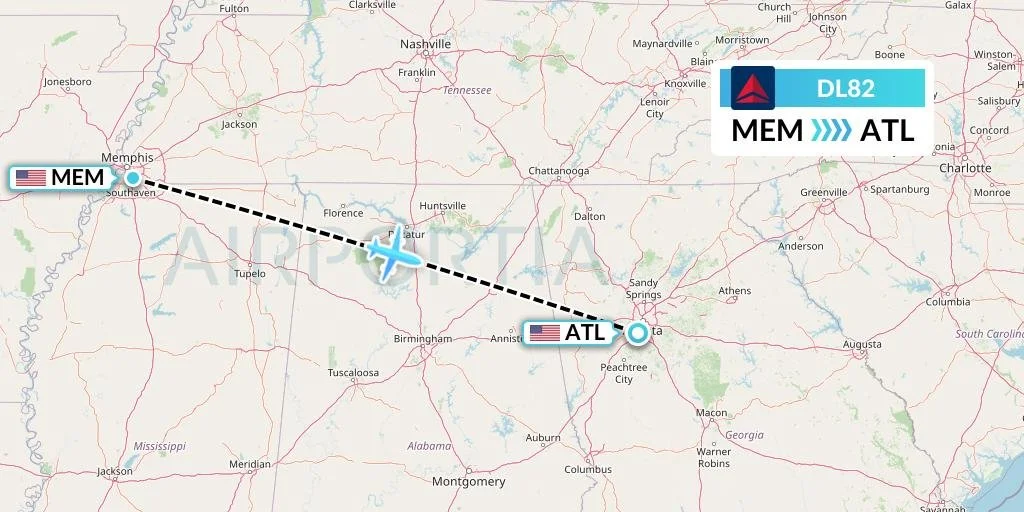
This map shows how close the cities are. As someone who lives in Memphis and connects through Atlanta as a Delta flyer, I see why DA found it redundant to have two hubs this close.
It makes better sense to have one hub the Southeast US versus two if one is only needed.
Credits: Airportia
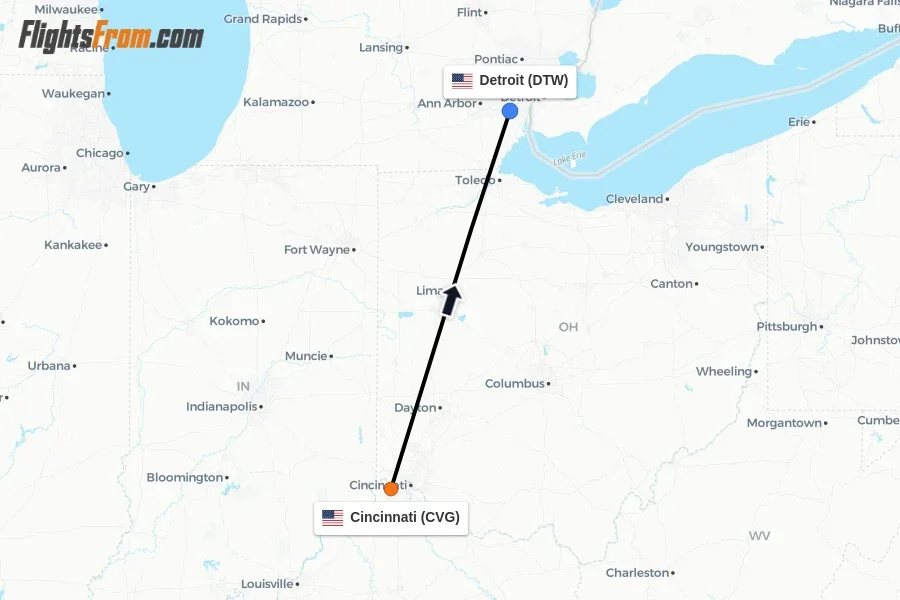
This map shows how close Detroit and Cincinnati are. Once again, redundant for the airline to maintain.
Credits: FlightsFrom.com
In Delta’s 2008 SEC filing, they mentioned Memphis competed with Atlanta and Cincinnati overlapped substantially with Detroit. Detroit and Cincinnati’s overlap was specifically about the flight schedules and routes they served. Almost identical.
Another issue was the inefficient regional jets. Both Memphis (MEM) and Cincinnati (CVG) both HEAVILY relied on 50-seat regional jets. That became an issue when fuel cost rose and the jets became more expensive per seat to maintain.
Delta mentioned the 50-seat jet’s becoming economically unattractive. With MEM and CVG being big regional jet hubs, it no longer became feasible to maintain them when Memphis traffic can funnel through Atlanta, and Cincinnati traffic can funnel through Detroit.
Another way to picture it is:
Retire 50-seat regional jets → eliminate marginal routes → shrink smaller hubs (MEM & CVG) → consolidate connections through larger hubs (ATL & DTW)
Now, mentioned before, Memphis has regional demand. The headquarters of multiple worldwide giants such as FedEx, St. Jude, AutoZone, and more. However, Delta didn’t need to keep Memphis a hub to serve FedEx executives or Memphis business.
Delta, alongside the other airlines at Memphis, funnel MEM-originating passengers to bigger hubs, aka the ‘hub-and-spoke’ model. Memphis funnels Delta passengers through Atlanta, Minneapolis, Salt Lake City, and more recently into LaGuardia.
Case Study x Global Sales
Whilst that all is true, how does it tie back into Global Sales?
Well the Case Study background gave context. This leads into the understanding of how a global sales team in Delta can work in tandem with the decision to de-hub a city.
Global Sales isn’t just asking “Does Memphis have corporations?” because the answer is yes. They are asking “How valuable is the corporate travel demand in Memphis to Delta, and what is the most economically efficient way to serve it?”
Even though Memphis is no longer a hub, the airport has maintained it’s Delta SkyClub and has the biggest share in passenger totals at 25%, showing the airline still has legacy at the airport post-2013 hub status drop.
Let’s imagine an example. Delta has 500 employees at a Memphis company who travel internationally for business. The options are:
A) Make Memphis a hub again
Huge infrastructure, aircraft, crews, connecting traffic, and many routes. EXPENSIVE.
B) Keep Memphis an origin & destination (O&D) market
Serve important destinations directly and connect passengers through hubs for international travel. MUCH MORE FEASIBLE, and current positioning
C) Use corporate agreements
Offer the corporation: SkyMiles benefits, negotiated fares, premium cabin access, preferred routing, global network access, and more…W/O needing Memphis as a hub.
This is where Global Sales can preserve corporate value without preserving hub economics.
Takeaway from the Case Study
The Northwest-Delta merger changed the question from “Which cities historically have hubs?” to “Where should Delta concentrate commercial connecting capacity to maximize network profitability?”
Consolidation became the clear answer. And with Memphis, Atlanta was the dominant hub. The also began investing to other hubs strategically such as JFK/LGA, Boston, Seattle, and LAX while de-hubbing overlapping hubs such as Memphis and Cincinnati.
The de-hubbing of MEM and CVG was not global sales decision. How the airline maintained support to corporate and customer travel demand from Memphis and Cincinnati was their decision. And the fact that Delta has the largest market share still at the airport is telling of how the airline maintained connectivity without disregarding traffic to and from MEM and CVG.
Sources:
https://simpleflying.com/memphis-airport-history/
https://www.ajc.com/business/smaller-air-hubs-hit-hard-consolidation/8kDQ7PqyxOvUYbbIXNN7rO/?utm_
https://www.sec.gov/Archives/edgar/data/27904/000101968708005505/delta_fwp-121508.htm?utm_
https://www.businesstravelnews.com/Business-Travel/Delta-To-De-hub-Memphis?utm_
